

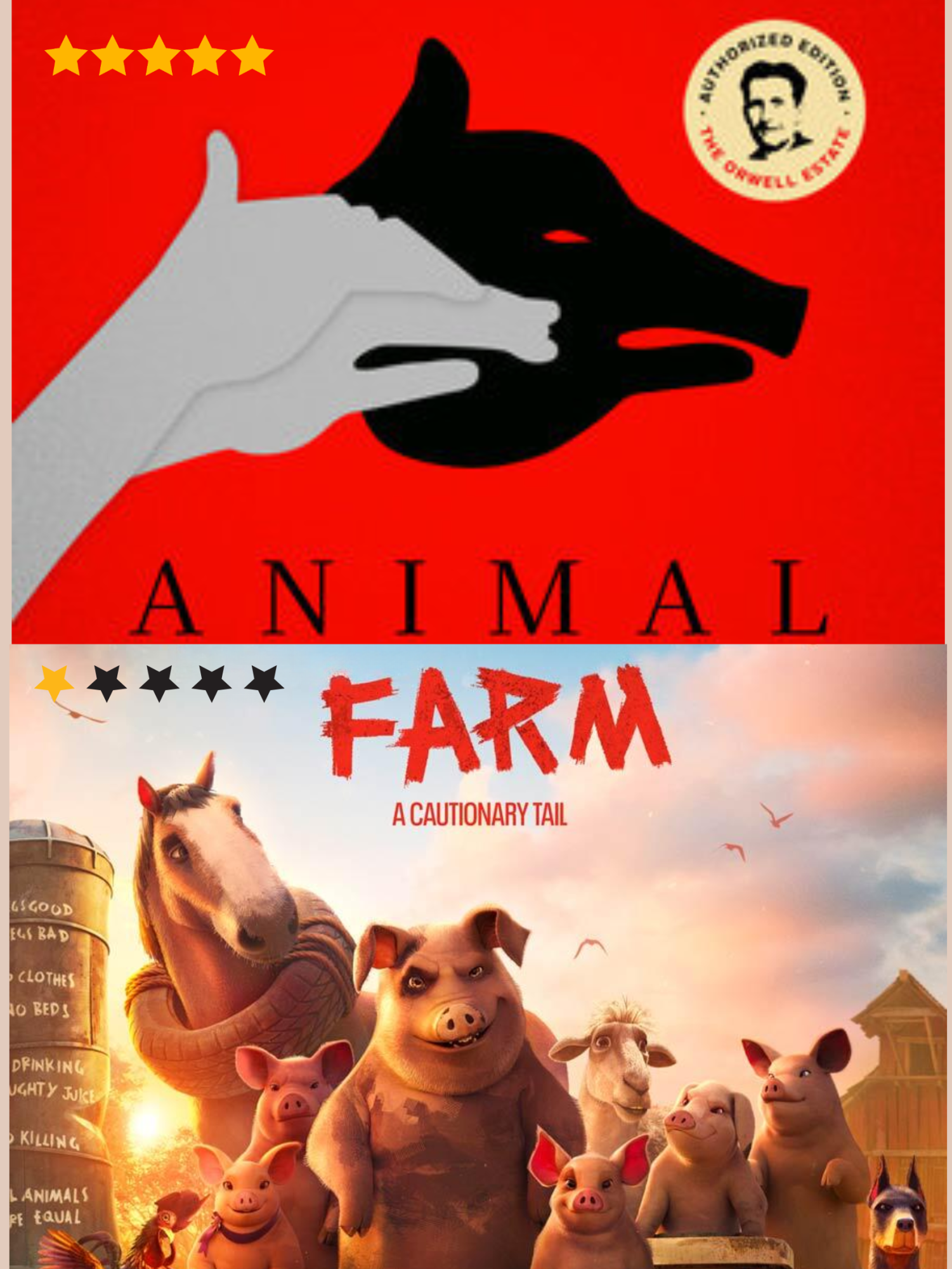
On May 1st, a cartoon adaptation of George Orwell’s 1945 Novel, directed by Andy Serkis, was released by Wonder Studios—known for Bible stories and the upcoming “Young Washington.” The comedy cartoon is an adaptation of Orwell’s novel, Animal Farm, which is a political allegory for the Russian Revolution. The movie has been changed from a deep, meaningful novel into a humorous kids’ movie, missing the entire point of the book.
The movie features voice actors Gaten Matarazzo, Seth Rogan, and other popular names. Although the movie has been in theatres for only a few days, it has received many critical responses, has a 24% on Rotten Tomatoes, and many reviewers see it as a “C-” film. In addition, many critics believe it undermines the novel’s impact. Today, many students in school read it as an important part of the English class due to its meaning.
“All animal farm adaptations are equal, but some are more watchable than others,” was a quote left as a consensus of critics on Rotten Tomatoes. This is a reference to one of the key lines in the book “All Animals Are Equal, But Some Are More Equal Than Others,” reflecting how the idea of the novel’s communism ultimately resulted in a form of elitism for the pigs. The quote left by the critic, which creates a comparison to the other movie version of Animal Farm, which was made shortly after the book in 1954. This adaptation, on the other hand, correctly captures the sharp edges of the story and the apolitical allegory behind it.
The plot begins similarly, with the farm becoming independent from Jones, leading to the pigs becoming “in charge” of the farm. A constant battle between Snowball and Napoleon for the leadership occurs, which connects to the book. In the book, Snowball represents Leon Trotsky, while Napoleon represents Joseph Stalin. The movie continues to gain ideas from the book, with the seven commandments, and the windmill they build for economic opportunities.
However, many differences allow the movie to miss the entire point of the book. The movie has a main character, “Lucky,” who is not in the book at all. Lucky works as a guide and helper to both Napoleon and Snowball. The movie becomes more of an allegory for capitalism instead of the Russian Revolution. The ending was the most significant difference, where instead of it being an intense, meaningful ending, it ended on a hopeful note for a successful rebellion. The end of the book was one of the most significant parts of it, highlighting how the pigs ended in tyranny, as they were unable to distinguish themselves from the man whom they overthrew in the first place, ultimately highlighting the corrupt political system. By changing this and making it more “child-friendly,” the importance of the book is essentially thrown away.
As a multiple-time reader of Orwell’s original work, I can tell you this movie is not worth the watch; it misses all of the key aspects of the book. George Orwell wrote his work to inform people of the dangers of political corruption, and something significant just simply can’t be made into a humorous kids’ movie.


